
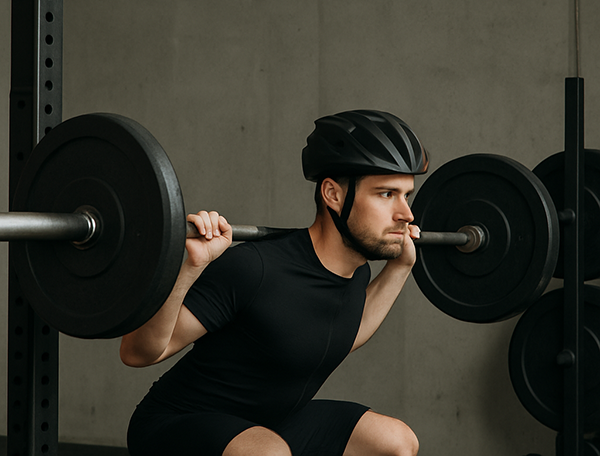
Cyclists are creatures of habit. For many, training means time in the saddle — chasing watts, climbing segments, or racking up winter turbo sessions. But the truth is, no matter how many miles you ride, there is a point where simply pedaling more stops delivering the gains you are looking for.
That is where strength training steps in.
Once considered the reserve of bodybuilders or sprinters, resistance work has quietly become one of the most powerful tools in endurance cycling. Done right, it will not bulk you up or make you slower — it will make you more efficient, resilient, and capable of holding higher power for longer. Whether you are an amateur racer or a weekend rider looking to ride stronger and feel fresher, strength training can transform your performance on the bike.
Why Cyclists Should Care About Strength Training
Every pedal stroke starts in your muscles. Your quads, glutes, hamstrings, calves, and even your core and upper body all work together to produce force and stability. Strength training enhances that system — improving the ability of your muscles to generate power and your body’s capacity to manage repeated efforts.
Think of it as building a stronger foundation. You would not construct a house on weak soil; in the same way, you cannot expect sustainable progress on the bike if the muscular base isn’t there to support it.
Research consistently shows that cyclists who include structured resistance training in their programmes see:
– Improved peak power and sprint capability.
– Enhanced time-trial performance through better force production per pedal stroke.
– Reduced fatigue and improved endurance efficiency at submaximal intensities.
– Lower injury risk, particularly in the knees, hips, and lower back.
Put simply — the stronger you are off the bike, the better you can perform on it.
The Science: Neuromuscular Efficiency and Power Transfer
One of the main ways strength training boosts cycling performance is through neuromuscular adaptations. That means your nervous system becomes more efficient at recruiting and firing muscle fibres.
When you first start strength training, you might not notice a huge change in muscle size, but you will see noticeable gains in control, coordination, and how much force you can produce. This neuromuscular efficiency is exactly what helps cyclists translate gym work into on-bike power.
A stronger muscle doesn’t just mean more brute force — it means more efficient force application with each pedal stroke. Over time, this leads to:
– Better pedal smoothness: improved recruitment patterns reduce wasted energy.
– Higher torque: allowing you to maintain power through climbs and sprints.
– Greater fatigue resistance: muscles can sustain submaximal output longer before breakdown.
So while cycling remains the sport of “aerobic power”, strength work refines the mechanical side of performance — making every watt go further.
How Strength Training Reduces Fatigue
Ever felt your legs fade in the final third of a long ride? Or struggled to maintain form during back-to-back training days? Strength training can help by addressing muscular endurance and durability.
Repeated contractions during cycling place huge stress on the same muscle groups. Strength training conditions those muscles to tolerate greater loads, increasing both their resilience and recovery rate.
Additionally, studies show that riders who lift regularly experience lower levels of creatine kinase (a marker of muscle damage) after hard sessions. This means less soreness, faster recovery, and the ability to handle greater training volume over time.
From a practical standpoint, that translates to:
– Longer rides without the same fatigue.
– Improved back and core stability on climbs or in the drops.
– Consistency across multi-day events or heavy training weeks.
Does Strength Training Make You Heavier?
It’s one of the most common concerns among endurance athletes — “won’t I just put on weight?”
In reality, the answer is no — not if it’s programmed intelligently. Cyclists aren’t training for hypertrophy (muscle growth for size), but rather for strength and neuromuscular efficiency.
With moderate volume, controlled nutrition, and a focus on compound lifts and functional movement, it’s entirely possible to gain strength with minimal or no increase in body mass.
In fact, cyclists who commit to even two short sessions a week often find their power-to-weight ratio improves — not because they’re lighter, but because they can produce more power per kilogram.
When to Add Strength Training
Timing is everything. Like structured riding, strength training should fit into your broader season plan, not compete with it.
– Winter and early base phase: The best time to establish and build your foundation. Gym sessions can be heavier and more focused on developing maximum strength.
– Spring and build phase: Shift focus to power development — lighter weights, faster lifts, and more explosive movements.
– In-season: Maintain gains with short, low-volume sessions once a week.
If you’re new to it, start small: two 45-minute sessions a week is enough to make a difference. Prioritise quality over quantity — your form and recovery matter more than how much weight you lift.
The Best Exercises for Cyclists
Strength training doesn’t need to be complicated. The key is to target the major muscles involved in pedalling, while also building balance and stability through the core and supporting muscles.
Lower Body:
– Squats (back, front, or goblet): Builds quads, glutes, and hamstrings — the main power producers.
– Deadlifts: Strengthens posterior chain and improves hip drive.
– Lunges and split squats: Improve balance and correct left-right imbalances.
– Step-ups: Great for single-leg strength and functional climbing power.
Core and Stability:
– Planks and side planks: Improve posture and protect lower back.
– Russian twists / Pallor presses: Build rotational stability for sprinting and climbing.
– Back extensions: Strengthen lower back for long hours in the saddle.
Upper Body:
– Pull-ups and rows: Build posture control and shoulder stability.
– Push-ups or bench press: Maintain balance between front and rear upper body strength.
Don’t forget mobility and activation work. Glute bridges, hip openers, and dynamic warm-ups help you move better — and avoid the stiffness that comes from long hours on the bike.
How to Integrate Strength and Ride Sessions
Balancing strength and endurance work is key. The two complement each other, but scheduling matters.
– Avoid heavy leg days before high-intensity interval sessions or long rides.
– If you’re short on time, combine gym work with endurance days rather than recovery days.
– Use lighter, explosive gym sessions midweek when you’re fresher, and move endurance volume to weekends.
For many cyclists, the most sustainable setup looks like this:
– Two gym sessions a week (e.g. Monday & Thursday).
– Two interval or quality ride sessions.
– One long ride and one recovery ride.
It’s a rhythm that allows both systems — strength and endurance — to progress without conflict.
The Coaching Perspective
At Ride Revolution, we see huge success when riders introduce structured strength work. It’s not about lifting as much as possible, but about lifting with purpose — building stronger, more stable, and more capable athletes.
The gains go beyond numbers on a power meter. Riders report improved handling, reduced knee pain, and greater consistency week to week. They recover faster and perform better when it counts — whether that’s a sportive, crit, or club ride sprint.
Strength training is the missing link in many cyclists’ routines — the key to unlocking more performance without more hours.
Start Building Strength That Works for You
If you’ve been relying solely on miles to make progress, now’s the time to expand your approach. Strength training doesn’t replace the bike — it amplifies it.
Even one or two focused sessions per week can deliver huge returns when programmed with your cycling goals in mind.
Want to learn how to integrate strength training into your winter or race-season plan?
Book a free consultation with Ride Revolution Scotland — and start building the strength that fuels your best season yet.